Goudappel Mobility Twin
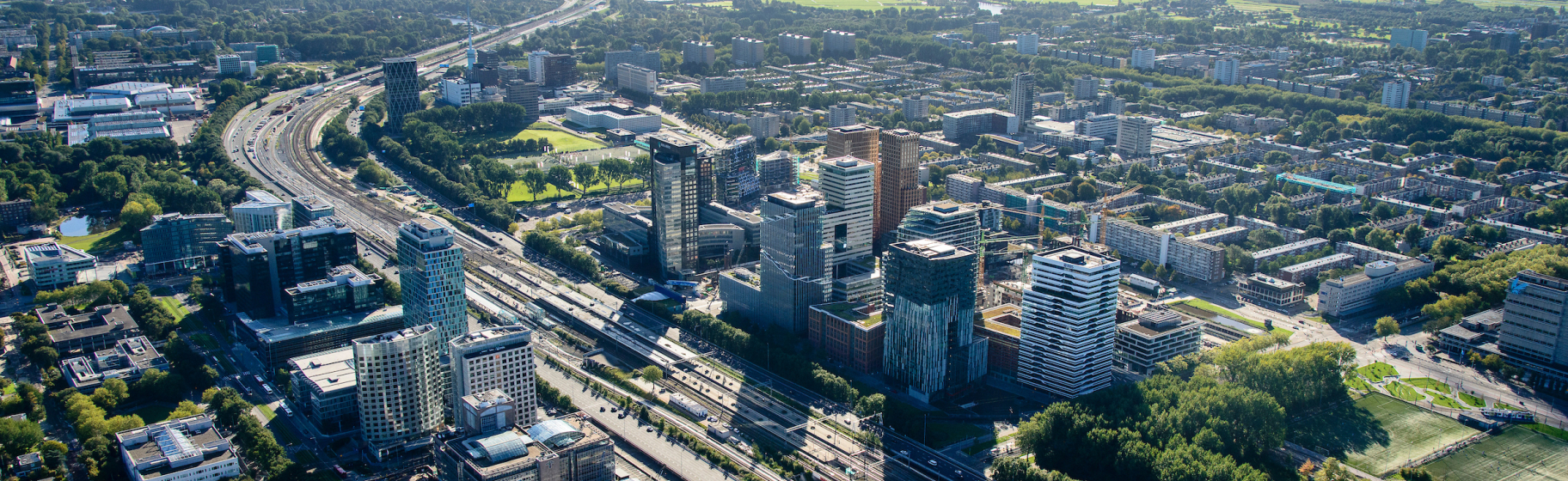
Balancing housing development, nitrogen reduction, climate goals, broad prosperity, the energy transition and infrastructure within the same limited space becomes increasingly complex. As these challenges accumulate, they require a comprehensive view and decision-making based on thorough insight, not only with regard to land use but also to the impacts on traffic and accessibility. Goudappel provides mobility insight as an integrable component for a complete virtual representation of the environment: the Goudappel Mobility Twin.
What is a digital twin?
A digital twin is a virtual representation of the real world. It allows you to access data about our world in an understandable intuitive way and to simulate the impact of specific interventions before it is implemented for real. For example, you can assess traffic conditions due to planned excavation works or a large events. It also helps to analyse and prepare for the effects of unexpected situations, such as extreme weather conditions or a major traffic accident.
When insight is needed into which parts of public space are affected and how different effects are interrelated, a digital twin provides a clear and practical solution. It is particularly suitable for addressing complex, integrated challenges. As simulations take place in a virtual environment, you can experiment freely without affecting the real world. This allows you to identify which measures deliver the desired results and to anticipate any unintended side effects. A digital twin combines data on the current situation with models that enable realistic simulations. As a result, costly delays and ineffective plans can be prevented.
What does the Goudappel Mobility Twin entail?
Goudappel provides all mobility-related data required to build a digital twin of public space. This mobility data is drawn from our own extensive and proprietary sources, including the Mobility Spectrum and the Dutch Travel Panel (Nederlands Verplaatsingspanel, NVP). By combining these two unique datasets, we can create a reliable picture of traffic conditions at a specific moment in time.
The Mobility Twin takes into account three key factors that strongly influence traffic patterns:
- Date: the day of the week and whether it falls within a holiday period;
- Time: the moment of the day;
- Weather: prevailing weather conditions, such as warm or cold, dry or rainy.
Together, these elements ensure a realistic and context-specific representation of mobility conditions.
What possibilities does the Goudappel Mobility Twin offer?
As part of a complete digital twin, the Goudappel Mobility Twin offers a range of practical applications, including:
- Exploring “what if” scenarios to understand how road closures affect regular traffic patterns.
- Assessing the impact of extreme weather on traffic by simulating the effects of flooding and heat stress.
- Simulating street liveability, enabling residents to see and in some cases experience through Virtual Reality how busy or safe and calm their environment could be.
The Goudappel Mobility Twin is particularly suited to time-specific, short-term insights. For strategic, long-term mobility questions, transport modelling is a more appropriate solution.
Digital twin demo
What makes the Goudappel Mobility Twin distinctive?
- We can display the expected traffic conditions at any time of day, in any location, and in all types of weather.
- Our mobility data covers all traffic flows, not only motorised traffic and public transport, but also cyclists and pedestrians.
- Our insights are grounded in data from 10 million annual trips, ensuring statistical reliability.
- Our data sources, the Mobility Spectrum and the Dutch Travel Panel (NVP), are unique in terms of data quality, detail, timeliness, and comprehensive nationwide coverage of the traffic network.
- We provide our mobility data in formats that are compatible with different digital twin viewers.
- Our data is efficiently made available through an API that complies with national and international standards.
- The underlying data service operates quickly, with response times ranging from one to several seconds.
A digital twin is a powerful tool for the integrated management and development of cities. The Goudappel Mobility Twin provides the mobility data required for a complete digital twin.