SUMP (Sustainable Urban Mobility Plans) Training and Capacity Building in EU countries

By the end of 2027, having a Sustainable Urban Mobility Plan (SUMP) is a requirement for 431 European cities classified as an urban node on the TEN-T network. To enhance the expertise of urban mobility planners with SUMP knowledge, the EU started a support program for cities and national governments. Goudappel, - as part of a consortium led by TRT, has been commissioned by the European Investment Bank/Jaspers to implement this program for SUMP Training and Capacity Building in multiple EU countries.
About SUMP
A Sustainable Urban Mobility Plan (SUMP) is a strategic plan in accordance with EU guidelines. Important aspects of a SUMP are urban logistics, participation and monitoring and evaluation of progress towards sustainability goals.
Working together on Sustainable Urban Mobility Plans
A SUMP is an integrated plan for sustainably improving mobility in a city or region, in order for mobility to contribute to the liveability of the area.
Read more
About the project
In collaboration with TRT, DTV Consultants, TREDIT, TIS, Stratec en Eurocities, we host more than 20 training sessions and workshops for mobility experts in important European cities, such as Bucharest, Prague, and Dublin.
Subjects covered during these sessions include:
- City oriented SUMP training: including SUMP methodology, strategic planning, organizational aspects, climate change, environmental considerations, stakeholder engagement, communication and promotion, demand analysis, spatial planning, freight and lofistics, innovation, traffic safety, and social inclusion.
- National SUMP Support Programmes (NSSP): NSSP concepts, EC guidance, guest speakers, Q&A sessions, systemic barriers, national legislations, SUMP financial support, SUMP platforms, SUMP guidance, and monitoring and evaluation at the national level
The SUMP training sessions and NSSP workshops are delivered by 4 key experts, including Goudappel’s Christiaan Kwantes. They are supported by a pool of other experts.
Strenghten SUMP implementation and governance
The primary goal of this project is to improve the technical and policy expertise of urban transport planners regarding SUMPs and by doing so facilitate the SUMP implementation at a city and regional level. This will consequently strengthen SUMP implementation and governance across Europe.
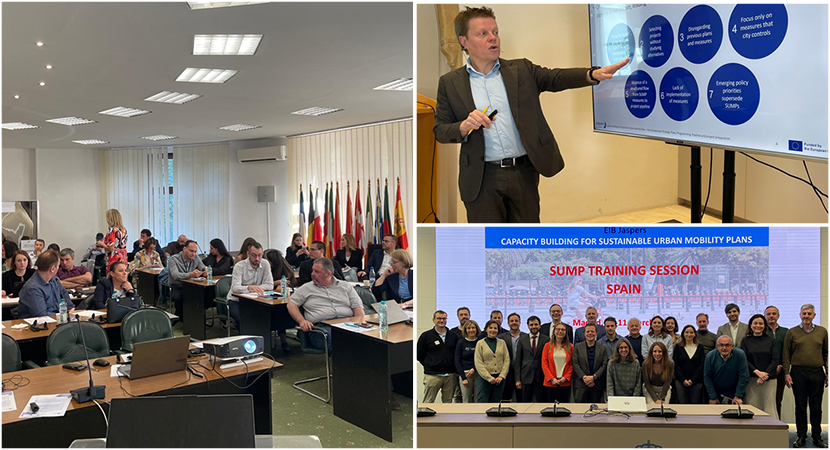
An impression of the training sessions in different European cities
Key take-aways
Since the start of the project, we visited mobility experts in several European countries, including Cyprus, Finland, Greece, Ireland, Croatia, Romania, Spain and the Czech Republic. Countries such as Sweden, France and Poland are still on the agenda.
Some key takeaways we share with them:
- The importance of a vision-driven approach: instead of focusing on today's problems (common in past mobility policies), SUMPs focus on a vision of tomorrow's city. This change of perspective opens windows for unexpected ways of thinking and acting and finding a different kind of measures.
- Create measures linked to your vision for greater stakeholder support: stakeholder participation is often very challenging when designing ambitious mobility policies. Especially when these policies impose restrictions on users. Creating measures that are closely linked to a SUMP's vision and objectives helps to explain a SUMP well to all stakeholders.
- Work on complementary measures: a list of separate, unrelated measures is unlikely to have the desired effect. By choosing measures that complement each other, you will not only achieve the stated goals but you will also ensure greater acceptance of measures. An example: measures such as paid parking and lower parking standards are only acceptable for stakeholders if you also invest in alternatives, such as attractive public transport.
- Pay attention to the local context: every country has it own experiences with mobility planning, which influences how quickly the SUMP methodology is adopted. The Netherlands, for example has a long tradition of mobility planning in comparison with other countries. It is therefore important to pay attention to the local context when using the SUMP methodology.
Valuable experience
Exchanging knowledge and sharing experiences with mobility experts all over Europe is also hugely valuable for the SUMPs we are working on ourselves, such as Düzce in Turkey.
Client: European Investment Bank (EIB)
Year: 2023 – ongoing
Involved advisors
-
Gerard Bruil
team manager international urban mobility
-
Christiaan Kwantes
mobility strategist